Trust Daylight, Not Strip Lights: A Colour Check for Clearance Furniture

There is a particular kind of regret that arrives about twenty minutes after a clearance sofa lands in a North East living room. In the warehouse it looked soft and neutral. At home, under a grey November sky and a north-facing window, it has gone faintly lilac. The walls look wrong. The floor looks wrong. The dog has already claimed it.
None of this means you bought badly. It means you bought under different lighting. Warehouse units are built for stacking pallets and spotting forklifts, not for showing off the finer points of a wool mix. The lights are usually high, bright and cool, and that changes how colour reads. A bargain is only a bargain if it works in your room, so it is worth spending twenty minutes testing before you spend forty quid on a van.
Strip Lights Are Doing the Selling
Most warehouse lighting is designed to be efficient, not flattering. Cool white LEDs and high-bay fittings strip out some of the warmth that makes a fabric look cosy. Pale greys can read sharper and more blue. Creams can look cleaner than they are. Oak veneer, under a hard light, can lose its honeyed middle and push towards orange at the edges. And if there is any daylight coming through a loading door, it is probably coming from one direction only, which means one side of the sofa is telling a different story to the other.
That is not a con. It is just a warehouse being a warehouse. Your job is to see the piece under more than one kind of light before you commit.
Take the Sample for a Walk
If you are buying a sofa, chair or anything upholstered, ask whether there is a fabric swatch you can borrow or buy. Many clearance pieces come with a sample book or a loose swatch tucked behind the cushion. If not, a close-up photo is better than nothing, but a physical sample is much better. For wood pieces, ask for a spare shelf, a drawer front that is already loose, or a small offcut if one is going spare. Even a paint colour card from a DIY shop can help you compare the undertone.
Then take it outside. Not to the loading bay under a yellow security lamp — to actual daylight, preferably near the car park or the pavement. Hold the swatch flat, not crumpled. Look at it against a white piece of paper or a plain wall. This is the closest you will get to the light that will hit it in your house.
Your Room Has Its Own Weather
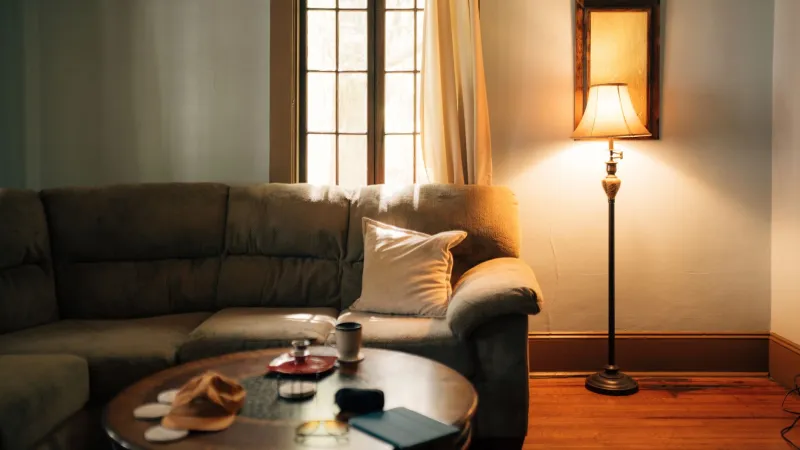
A room in Heaton does not get the same light as a bungalow in Northumberland or a flat in South Shields with a big bay window. North-facing rooms tend to pull colour cooler. South-facing rooms warm everything up. If your living room has a radiator under the window, a dark corner and a standard lamp with a warm bulb, the furniture will be seen under at least three different conditions before teatime.
So test at home as well. Take your swatch or photo and look at it in the morning, in the afternoon and with the main light on in the evening. If the colour only works at one time of day, you need to decide whether that is the time of day you actually use the room. For most of us, the evening lamp-lit version matters most.
Photograph It Properly
Phone cameras can lie, but they are still useful if you use them carefully. Turn the flash off. Stand near a window with the piece or swatch in daylight. Put a sheet of white A4 paper in the frame so the camera has something neutral to balance against. Take one wide shot showing the furniture beside the wall or floor, and one close-up showing the weave, grain or finish.
If you are in the warehouse, take a photo of the piece next to something you know — a white wall, a grey metal shelf, a wooden pallet. That gives your eye a reference point later. Avoid photos taken under the strip lights and then viewed on a bright phone screen. That is how a warm grey becomes a cool blue and you start questioning your own sanity.
Read the Undertones, Not the Label
Labels are broad. "Grey" can be blue-grey, green-grey, brown-grey or a soft greige. "Oak" can be pale and creamy or deep and orange. "Cream" can be buttery, chalky or almost yellow. "Charcoal" can be nearly black or a soft slate. The word on the ticket is a starting point, not a guarantee.
What matters is undertone. Hold the sample against your wall colour and flooring. Does it pull warm or cool? Does it make your wall look pink, or your floor look yellow? If you have a laminate or tile offcut, take it with you. If not, a photo of the floor in daylight is better than relying on memory. You are not looking for a perfect match — you are looking for a colour that does not fight.
When It Is Nearly Right
Sometimes the piece is close but not quite. Maybe the sofa is a touch cooler than the room, or the oak table is slightly more orange than the floor. That is where cheap accessories earn their keep. A warm throw, a couple of cushions, a rug with the right undertone or a lampshade that softens the bulb can pull a near-miss back into line. You are talking £10 to £25, not a new suite.
But be honest about the scale of the problem. If the colour clash is obvious across the whole piece, accessories will only decorate the argument. A cream armchair that looks lemon beside your walls is not going to be saved by a cushion. Walk away. The right piece will come round again.
The Van Decision
Clearance furniture is usually sold as seen, and van hire is not free. A local self-drive van might cost £40 to £80 for the day, plus fuel and a mate's bacon sandwich. That is a real cost, so do not let it push you into buying something you already doubt. Use a simple rule: if the colour works in daylight, works in your room and sits happily with your walls and floor, buy it. If two out of three are shaky, sleep on it. If all three are wrong, leave it in the aisle.
A Quick Colour Check Before You Pay
- Take a fabric or wood sample into real daylight, not just under the warehouse roof.
- Photograph the piece with flash off, beside something white, and view the photo on a neutral screen.
- Compare the undertone with your wall paint, floor and existing furniture.
- Check morning, afternoon and evening light in the actual room.
- Budget £10–£25 for a throw, rug or lampshade if the colour is close but not perfect.
- Remember the van cost when you are deciding. A cheap sofa that clashes is not cheap.
Warehouse lighting is there to sell furniture. Daylight is there to tell you the truth. Take the sample for a walk, trust your own room, and the piece you bring home will look like the one you chose.