The Fourth Move Test: Clearance Furniture That Survives Flat-to-Flat Life
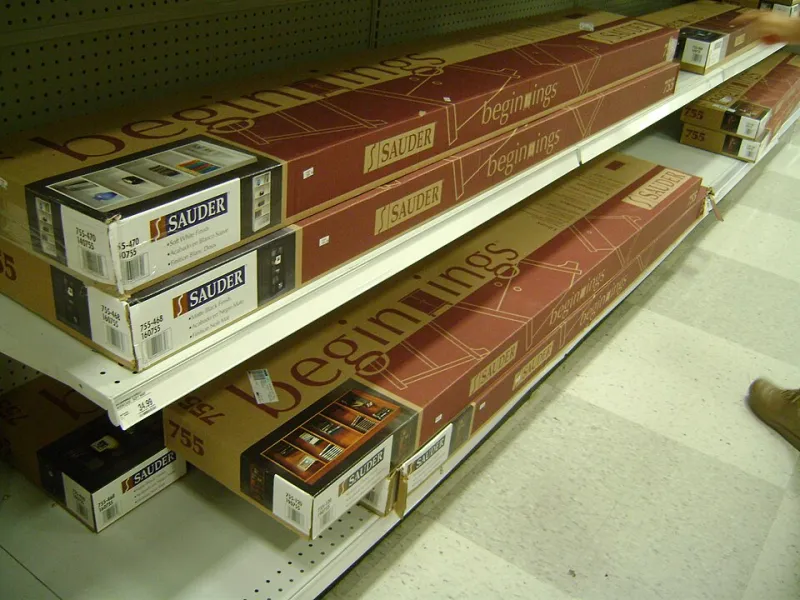
Photo: Doug Coldwell, CC BY-SA 3.0, via Wikimedia Commons
Renting in the North East tends to mean moving more often than anyone plans for. A twelve-month tenancy rolls round, a flatmate leaves, a better street turns up two streets over, and suddenly you are pricing a self-drive van for the third Saturday in a row. Furniture bought in a hurry at 22 has a habit of not surviving to 25.
So when you are stood in a warehouse aisle looking at a clearance wardrobe with a £75 sticker on it, the question is not whether you like it. It is whether it will still be standing in two flats' time, and whether you will still be able to get it up a stairwell.
That is the fourth move test. Here is how to apply it.
Joints are the whole story
Pick the piece up and put it down again — actually lift one corner. A flat-pack chest of drawers that flexes like a paperback will not survive being carried down two flights and up three.
Look at how it is held together:
- Cam locks and dowels. Standard flat-pack. Fine for one assembly, rough for two. If the cam holes are chewed or the dowels are loose in their sockets, it is a one-move piece.
- Confirmat screws. The chunky threaded ones that go straight into the board edge. Much better. Unscrew, flat-pack, rebuild.
- Glued and pinned. Solid, but it is not coming apart again. It moves as a whole unit, so it needs to fit through a door as a whole unit.
- Metal brackets and bolts. The best of the bunch on clearance stock. Beds, tables, decent shelving.
Turn it upside down if the staff will let you. Splits around a cam fitting, or a screw that spins without biting, tell you exactly how the next move will go.
Weight is a rental tax
A solid pine chest of drawers weighs roughly twice what a chipboard one does. That is the trade: it will outlive you, but you will pay for it in stairwells.
Be honest about your building. Third floor, no lift, narrow turn at the half-landing, van parked 40 metres away on a terraced street — that is a two-person job minimum. If you are doing it with one mate and a hand trolley, a 90kg sideboard stops being a bargain somewhere around the second landing.
A rough rule: if you cannot shift it yourself with a sack barrow, you need to know two people who will answer the phone on a Sunday.
Modular earns its keep
Anything that comes apart into smaller, lighter pieces is worth more than its price tag.
Sofa modules with proper metal connectors, nest of tables, stacking stools, shelf units that split into two halves, bed frames with a bolt-on headboard. These are pieces that fit a future flat you have not seen yet — a bay-windowed Tyneside tenement, a new-build with a 700mm doorway, a box room off the Ouseburn.
Monolithic is the enemy. A one-piece three-seater sofa is lovely until the day you meet a dog-leg staircase.
The wall problem
Most tenancy agreements will not let you drill, and even the ones that do tend to expect you to fill and paint before you leave. So anything tall needs to stand up on its own merits.
Which means: skip the tall glass-fronted bookcase, however cheap. Skip the narrow, deep shelving unit that is begging to tip the first time a cat lands on it. Take the wide, low, heavy-based unit every time.
If you must have height, get something with a genuinely wide footprint and put the heavy things at the bottom. Command strips are fine for picture frames and a mirror. They are not a substitute for a bracket, and no warehouse bargain is worth a trip to A&E.
What is worth the van trip
Worth it: metal bed frames with bolted joints, solid wood dining tables that split at the leg, upholstered ottoman storage beds if the gas struts are healthy, small side tables, ladder-style shelves with a proper wide base, and a decent mattress bought new rather than clearance.
Not worth it: MDF wardrobes over 1.8m, anything with a glass top, flat-pack desks with a single centre leg, chipboard bookcases already showing sag, and any piece that wobbles on the warehouse floor. It will not stop wobbling at home.
Run the deposit maths, not the sticker maths
A £55 flat-pack wardrobe sounds like a steal until it fails on move two and you are buying another one. A £140 solid pine chest of drawers that does four moves costs you £35 a move and holds its value.
Add the van, too. If a piece needs a Luton rather than a hatchback, that is £40 to £60 of the saving gone before you have left the car park. Clearance savings evaporate quietly in the back of a hire van.
If you are moving every year, the cheap-and-light option is often right for small stuff, and the heavier, bolted option is right for anything you sit on or sleep in.
The two-minute aisle checklist
- Lift one corner. Does it flex?
- Rock it. Does the joint move before the leg does?
- Check the fixings: bolts good, cams okay, glue is a one-way ticket.
- Can you get it through a door on your own? Measure the narrowest point in your current flat before you go shopping.
- Does it come apart with a hex key, or a hammer?
- Is there any part of it you could not replace if it snapped?
Clearance furniture for renters is not about buying the cheapest thing in the aisle. It is about buying the thing that is still in one piece when you hand back the keys and ask for your deposit.